Look at what you already eat. Where are the eggs, tofu, fish or other foods that provide protein? HealthHub recommends including protein-rich foods in meals for older adults. Its My Healthy Plate guide uses a quarter of the plate for protein foods, a quarter for wholegrains and half for fruit and vegetables. Use those proportions as a guide and adjust portions to your needs. HealthHub’s nutrition guidance for older adults · My Healthy Plate meal examples
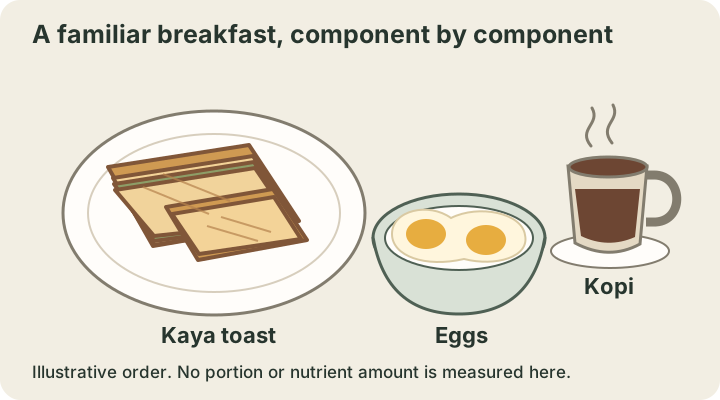
What the picture helps you notice: point to a component before trying to compare an entire meal. Here, the eggs provide protein. The drink’s name alone does not tell you its recipe, and the illustration gives no exact nutrient total. The same method works with tofu in economy rice or fish in sliced fish soup.
Build around what you already order
Breakfast example. If you usually order kaya toast with kopi, add the egg option if it suits you. The egg is the food you can point to as providing protein. The toast can stay part of breakfast, and fruit can fit at breakfast or later. The amount depends on what you order. HealthHub’s breakfast and other familiar meal examples
Eating-out example. At an economy rice stall, try choosing tofu or fish with rice and one vegetable dish. If you are deciding between two fish dishes, look at the portion actually served. The dish name or how it looks in a photo gives you too little information for a reliable protein figure. HealthHub’s hawker-centre guide
With chapati or thosai, look for the lentils in the dhal. With sliced fish soup, check how much fish comes with the noodles and broth. Recipes, portions and the amount of protein vary from stall to stall. HealthHub’s meal examples · HealthHub’s hawker-centre guide
Use the label when you can
Packaged drink example. Vitasoy Singapore lists one 250 ml serving for each of these products. We checked the manufacturer’s published panels on 19 November 2026. The per-100-ml figures below use the printed serving figures divided by 2.5. Vitasoy Original Soy Drink · Vitasoy Soy Drink Not So Sweet
| Vitasoy Singapore soy drink | Protein per 250 ml | Sugars per 250 ml | Protein per 100 ml | Sugars per 100 ml |
|---|---|---|---|---|
| Original Soy Drink | 7 g | 16 g | 2.8 g | 6.4 g |
| Soy Drink (Not So Sweet) | 7 g | 10 g | 2.8 g | 4.0 g |
If you want less sugar in the same size drink, the Not So Sweet panel shows 6 g less sugar per pack and the same protein. It still lists sugar and fructose among its ingredients. For drinks in different pack sizes, compare the same volume first, then check how much you are likely to drink. Check the carton when you buy it as the recipe or serving size can change. HealthHub’s food label guide
Keep the comparison useful: say which nutrient, which amount and which product you compared. “Same protein per 250 ml, different sugars” is more specific than calling one whole drink healthier. A label comparison answers that limited question and does not decide your individual diet.
Choose one meal to make easier
Write down a typical breakfast, lunch and dinner. Underline the ingredients that give you protein. If lunch usually has tofu or fish, you might start by keeping eggs or yoghurt at home for breakfast.
If you have kidney disease, difficulty swallowing or a diet prescribed by a clinician, ask your healthcare team before changing your portions or protein intake. A dietitian can help you plan meals around your needs. HealthHub’s advice on protein for older adults
Which drink has more protein in the same amount?
Interactive example · Explanation explored
Which drink has more protein in the same amount?
Two fictional drinks have different pack sizes. First choose a common volume for the comparison.
Show the explanation
Use the per-100-ml column to compare an equal amount: A has 3 g protein and B has 2 g. Then check what you will actually drink. A’s 250 ml pack has 7.5 g protein; B’s 400 ml pack has 8 g because it contains more drink. This comparison describes these two nutrients and quantities; it does not choose a drink for your individual needs.
Keep in mind
Compare the same volume first. Then check the pack or portion you will drink; a larger pack can have a larger total even when its per-100-ml value is lower.
Saved in this browser. No automatic sync between devices.
Fictional teaching labels. These are not real products.
Fictional Drink A
Per 100 ml
- Protein
- 3 g
- Total sugar
- 4 g
Fictional Drink B
Per 100 ml
- Protein
- 2 g
- Total sugar
- 3 g
Read both quantities in a table
| Drink | Quantity | Protein (g) | Total sugar (g) |
|---|---|---|---|
| Fictional Drink A | 100 ml | 3 | 4 |
| Fictional Drink A | 1 pack, 250 ml | 7.5 | 10 |
| Fictional Drink B | 100 ml | 2 | 3 |
| Fictional Drink B | 1 pack, 400 ml | 8 | 12 |
Sources and example notes
Fictional Drink A: 250 ml pack, 3 g protein and 4 g sugars per 100 ml. Fictional Drink B: 400 ml pack, 2 g protein and 3 g sugars per 100 ml.
- HealthHub: Understanding food labels — Nutrition panels distinguish per-serving and per-100-g/ml values. Compare equivalent quantities. Fictional lesson numbers are original arithmetic examples, not HealthHub product data.
Reviewed . Publisher: SG Home Wellness. How we review and correct content.
What changes when you read the whole pack?
Interactive example · Explanation explored
What changes when you read the whole pack?
A fictional 300 ml carton lists protein and sugars per 100 ml. You want to understand the amount in the carton.
Show the explanation
A 300 ml carton contains three lots of 100 ml. Multiply the per-100-ml values by 3: 2.5 g protein becomes 7.5 g and 4 g sugars becomes 12 g for the whole carton. Check the actual label for the pack volume, serving size and servings per pack. A manufacturer’s serving and a whole pack are not always the same amount.
Keep in mind
Per-pack amount = per-100-ml value × pack ml ÷ 100. Check whether the label describes one serving or the whole pack.
Saved in this browser. No automatic sync between devices.
Fictional teaching labels. These are not real products.
Fictional 300 ml carton
Per 100 ml
- Protein
- 2.5 g
- Total sugar
- 4 g
Read both quantities in a table
| Drink | Quantity | Protein (g) | Total sugar (g) |
|---|---|---|---|
| Fictional 300 ml carton | 100 ml | 2.5 | 4 |
| Fictional 300 ml carton | 1 pack, 300 ml | 7.5 | 12 |
Sources and example notes
Fictional 300 ml carton. Per 100 ml: protein 2.5 g, sugars 4 g. Whole 300 ml carton: protein 7.5 g, sugars 12 g.
- HealthHub: Understanding food labels — Nutrition panels distinguish per-serving and per-100-g/ml values. Compare equivalent quantities. Fictional lesson numbers are original arithmetic examples, not HealthHub product data.
Reviewed . Publisher: SG Home Wellness. How we review and correct content.
Where is the protein in this breakfast?
Interactive example · Explanation explored
Where is the protein in this breakfast?
An illustrated breakfast has kaya toast, eggs and kopi.
Show the explanation
The eggs are a recognisable protein-containing component in this breakfast. Other familiar options include tofu, fish, yoghurt and lentils in meals that use them. Start by identifying the ingredients you actually eat. Portions, allergies, preferences and any prescribed diet still matter; this example does not calculate a meal’s nutrients or recommend it for every person.
Keep in mind
Point to a protein-containing ingredient in the meal you already eat, such as eggs, tofu, fish or lentils. The ingredient and portion matter more than the dish name.
Saved in this browser. No automatic sync between devices.
Kaya toast
Toast is part of this breakfast. The amount and recipe affect its nutrients; this illustration does not estimate them.
Eggs
Eggs are a clear protein-containing component you can identify in this breakfast.
Kopi
Milk and sugar vary with the order. A cup’s appearance does not establish its nutrient content.
Sources and example notes
Illustrated kaya-toast breakfast: toast on a plate, two eggs in a small bowl and a cup of kopi. The eggs are the highlighted protein-containing component; no nutrient total is supplied.
- HealthHub: Seniors Need More Protein — Familiar protein-containing foods including eggs, tofu, fish and lentils. No numerical meal estimate or individual target is taken from this lesson.
Reviewed . Publisher: SG Home Wellness. How we review and correct content.
Can a fish-soup photo tell you the protein amount?
Interactive example · Explanation explored
Can a fish-soup photo tell you the protein amount?
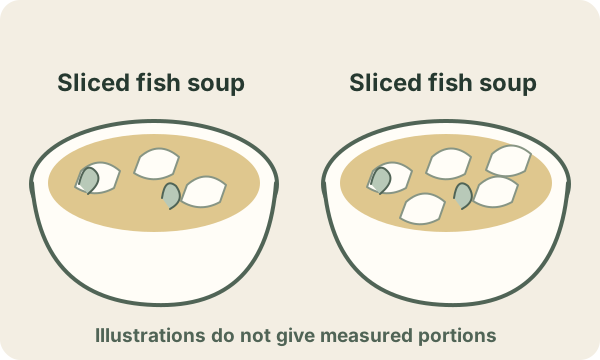
Two stalls both call a dish sliced fish soup. The bowls may contain different portions and recipes.
Show the explanation
A name or photo can help you recognise a food, but it does not establish the fish’s edible weight, the recipe or a precise protein amount. Ask what is included and look at the portion actually served. Use a reliable panel or a defined recipe and measured portion when numerical comparison is needed. A photo alone cannot supply that detail.
Keep in mind
Use a dish name to identify the meal, not an exact nutrient amount. Check ingredients and the portion actually served; do not turn a photo into a precise protein figure.
Saved in this browser. No automatic sync between devices.
Dish name
Sliced fish soup
Recognises a type of dish.
Still unknown
Actual fish amount and recipe
Piece size, ingredients and portion can vary.
Sources and example notes
Two illustrative bowls labelled sliced fish soup. One drawing shows fewer fish pieces, the other more. They do not establish edible weight, recipe or an exact nutrient amount.
- HealthHub: Survive Hawker Paradise — Hawker-food choices and portions need context; a dish name alone is not a nutrient panel.
- HealthHub: Seniors Need More Protein — Familiar protein-containing foods including eggs, tofu, fish and lentils. No numerical meal estimate or individual target is taken from this lesson.
Reviewed . Publisher: SG Home Wellness. How we review and correct content.
Quick reference
Collection information
How do I compare two food labels?
Read the current pack. Products and serving sizes can change.
How do I compare two food labels?
Read the current pack. Products and serving sizes can change.Check that you are comparing the same amount, such as protein per 100 ml. Then work out what is in the serving you drink. For example, 2.8 g per 100 ml is 7 g in 250 ml. Check sugar and ingredients too, especially if you have dietary restrictions.
See the documented soya milk comparisonFull reference: https://sghomewellness.com/guides/singapore-meals-for-strength-training/#use-the-label-when-you-can
Content reviewed 2026-11-19.
Sources HealthHub food label guide