Practical examples
One useful thing at a time.
Explore any explanation. Save a reminder if it will help next time. These are references, rather than a workout or a test of your technique.
Choose an example to explore. Each example keeps its own explanation and saved reference.
Understand my gym
Find the model, understand its controls and ask a useful setup question.
Which control changes the seat, and which changes the resistance?
Interactive example · Explanation explored
Which control changes the seat, and which changes the resistance?
You are looking at a Hammer Strength Select Seated Leg Press, model HS-SLP.
Show me the difference
On this HS-SLP leg press, the release lever on the left side of the seat adjusts the starting position. The weight-stack selector chooses resistance. These are separate jobs. This model uses the seat adjustment to change the start position; another machine may have a separate range or handle control. Check the exact model instructions and ask for help if an adjustment is unclear or will not lock.
Keep in mind
HS-SLP: seat release = starting position; weight-stack pin = resistance. Check the model instructions and that adjustments lock.
This is the HS-SLP example, not a setting to copy to another machine. It does not choose a suitable position or resistance for you.
Saved in this browser. No automatic sync between devices.
Seat release lever
Starting position
On the HS-SLP, the seat adjustment changes where the press begins.
Weight selector pin
Resistance
Selects the stack setting. It does not change where you sit.
Sources and example notes
Two controls on the Hammer Strength HS-SLP have separate jobs: the seat release changes the starting position; the weight-stack pin selects resistance. See the linked manufacturer diagram for their locations.
- Hammer Strength Select owner’s manual, HS-SLP setup, printed page 52 — The left-side seat lever adjusts start position; selected resistance is checked separately.
Reviewed . Publisher: SG Home Wellness. How we review and correct content.
What name should you look up?
Interactive example · Explanation explored
What name should you look up?
You have found a seated leg press, but the gym has several brands.
Show me the difference
Find the brand and model code, such as Hammer Strength HS-SLP, then match them to the manufacturer’s instructions. A serial number identifies the individual unit. If the label is missing or unreadable, ask management for the model and its instructions rather than choosing a similar-looking machine online.
Keep in mind
Identify the brand and model before looking up instructions. If the label is unclear, ask management; a similar-looking machine may work differently.
Saved in this browser. No automatic sync between devices.
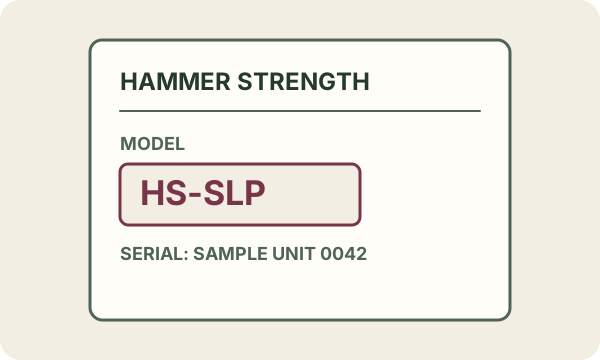
Model
HS-SLP
Identifies the equipment type to look up.
Serial number
Sample unit 0042
Identifies one particular unit, not the exercise instructions.
Instruction placard
Setup diagram
Shows instructions attached to this machine.
Sources and example notes
Example label for Hammer Strength Select Seated Leg Press. Model: HS-SLP. Serial number: sample unit 0042. Instruction placard: the machine’s setup and movement diagram.
- Hammer Strength Select owner’s manual, label diagram p.15 and HS-SLP setup p.52 — HS-SLP identification labels and model-specific control functions. No universal seat or resistance setting is supplied.
- Life Fitness manuals and resources — Find model-specific equipment instructions.
Reviewed . Publisher: SG Home Wellness. How we review and correct content.
A number is visible. What else do you need?
Interactive example · Explanation explored
A number is visible. What else do you need?
A fictional cable station has a stack marked 20 kg, an attachment beside it and an unreadable instruction placard.
Show the explanation
The stack number alone leaves important questions unanswered: which attachment belongs to the machine, what each adjustment changes and how to check it is secured. Find the exact model instructions and ask management or a qualified trainer to show you. Leave loose, worn or damaged equipment alone and report it.
Keep in mind
If setup is unclear, ask for the model instructions, attachment check and adjustment-lock demonstration. A visible stack number is not a complete setup.
Saved in this browser. No automatic sync between devices.
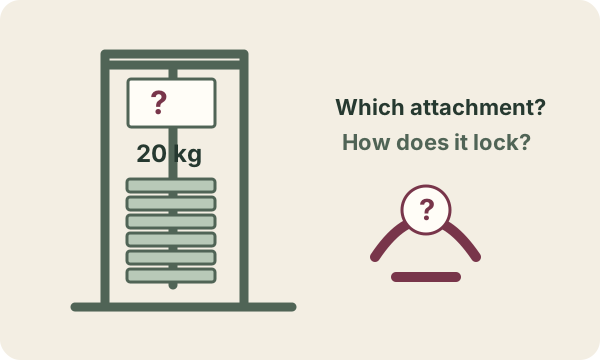
Known
Stack marked 20 kg
A visible number does not explain setup.
Unknown
Attachment and lock check
Does this attachment belong here, and how is it secured?
Needed
Exact model instructions
Ask management or a qualified trainer to identify and explain the setup.
Sources and example notes
Fictional cable station checklist: stack number visible; attachment compatibility unknown; model instructions unreadable; adjustment lock check not demonstrated.
- Life Fitness manuals and resources — Find model-specific equipment instructions.
- HealthHub: Don’t Forget Your Form — Qualified help with understanding exercise setup and technique.
Reviewed . Publisher: SG Home Wellness. How we review and correct content.
Does 20 kg mean the same thing on both machines?
Interactive example · Explanation explored
Does 20 kg mean the same thing on both machines?
You move between two cable-station models. In this fictional record, both stacks display 20 kg.
Show me the difference
Machine mechanics matter as well as the label. Life Fitness, for example, has cable stations with 2:1 and 4:1 resistance systems. Do not carry a stack number from one model to another as though the resistance were identical. Record the machine model and units, and ask your coach how to compare practice when equipment changes.
Keep in mind
Keep the machine model and displayed units beside a resistance number. Matching numbers on different machines may not describe comparable practice.
Saved in this browser. No automatic sync between devices.
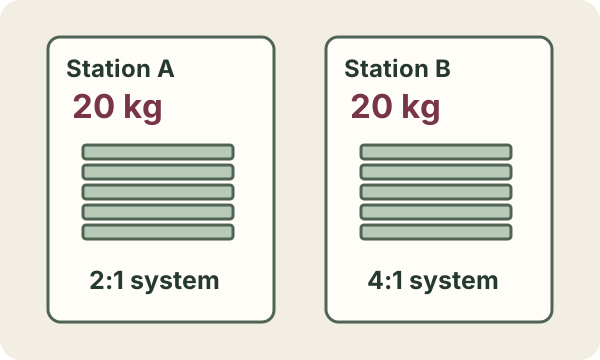
Cable station A
20 kg displayed
Model with a 2:1 resistance system.
Cable station B
20 kg displayed
Different model with a 4:1 resistance system.
Sources and example notes
Fictional comparison: cable station with a 2:1 system displays 20 kg; a different station with a 4:1 system also displays 20 kg. Equal stack labels are not an equal-resistance guarantee.
- Life Fitness Dual Adjustable Pulley, 2:1 model — Manufacturer identifies the 2:1 resistance system. Lesson stack numbers are fictional; no handle-force calculation is claimed.
- Life Fitness Dual Adjustable Pulley, 4:1 model — Manufacturer identifies the 4:1 resistance system. Different machine mechanics can prevent direct comparison of displayed stack numbers.
Reviewed . Publisher: SG Home Wellness. How we review and correct content.
Make sense of food choices
Compare quantities and recognise what a meal example can tell you.
Which drink has more protein in the same amount?
Interactive example · Explanation explored
Which drink has more protein in the same amount?
Two fictional drinks have different pack sizes. First choose a common volume for the comparison.
Show the explanation
Use the per-100-ml column to compare an equal amount: A has 3 g protein and B has 2 g. Then check what you will actually drink. A’s 250 ml pack has 7.5 g protein; B’s 400 ml pack has 8 g because it contains more drink. This comparison describes these two nutrients and quantities; it does not choose a drink for your individual needs.
Keep in mind
Compare the same volume first. Then check the pack or portion you will drink; a larger pack can have a larger total even when its per-100-ml value is lower.
Saved in this browser. No automatic sync between devices.
Fictional teaching labels. These are not real products.
Fictional Drink A
Per 100 ml
- Protein
- 3 g
- Total sugar
- 4 g
Fictional Drink B
Per 100 ml
- Protein
- 2 g
- Total sugar
- 3 g
Read both quantities in a table
| Drink | Quantity | Protein (g) | Total sugar (g) |
|---|---|---|---|
| Fictional Drink A | 100 ml | 3 | 4 |
| Fictional Drink A | 1 pack, 250 ml | 7.5 | 10 |
| Fictional Drink B | 100 ml | 2 | 3 |
| Fictional Drink B | 1 pack, 400 ml | 8 | 12 |
Sources and example notes
Fictional Drink A: 250 ml pack, 3 g protein and 4 g sugars per 100 ml. Fictional Drink B: 400 ml pack, 2 g protein and 3 g sugars per 100 ml.
- HealthHub: Understanding food labels — Nutrition panels distinguish per-serving and per-100-g/ml values. Compare equivalent quantities. Fictional lesson numbers are original arithmetic examples, not HealthHub product data.
Reviewed . Publisher: SG Home Wellness. How we review and correct content.
What changes when you read the whole pack?
Interactive example · Explanation explored
What changes when you read the whole pack?
A fictional 300 ml carton lists protein and sugars per 100 ml. You want to understand the amount in the carton.
Show the explanation
A 300 ml carton contains three lots of 100 ml. Multiply the per-100-ml values by 3: 2.5 g protein becomes 7.5 g and 4 g sugars becomes 12 g for the whole carton. Check the actual label for the pack volume, serving size and servings per pack. A manufacturer’s serving and a whole pack are not always the same amount.
Keep in mind
Per-pack amount = per-100-ml value × pack ml ÷ 100. Check whether the label describes one serving or the whole pack.
Saved in this browser. No automatic sync between devices.
Fictional teaching labels. These are not real products.
Fictional 300 ml carton
Per 100 ml
- Protein
- 2.5 g
- Total sugar
- 4 g
Read both quantities in a table
| Drink | Quantity | Protein (g) | Total sugar (g) |
|---|---|---|---|
| Fictional 300 ml carton | 100 ml | 2.5 | 4 |
| Fictional 300 ml carton | 1 pack, 300 ml | 7.5 | 12 |
Sources and example notes
Fictional 300 ml carton. Per 100 ml: protein 2.5 g, sugars 4 g. Whole 300 ml carton: protein 7.5 g, sugars 12 g.
- HealthHub: Understanding food labels — Nutrition panels distinguish per-serving and per-100-g/ml values. Compare equivalent quantities. Fictional lesson numbers are original arithmetic examples, not HealthHub product data.
Reviewed . Publisher: SG Home Wellness. How we review and correct content.
Where is the protein in this breakfast?
Interactive example · Explanation explored
Where is the protein in this breakfast?
An illustrated breakfast has kaya toast, eggs and kopi.
Show the explanation
The eggs are a recognisable protein-containing component in this breakfast. Other familiar options include tofu, fish, yoghurt and lentils in meals that use them. Start by identifying the ingredients you actually eat. Portions, allergies, preferences and any prescribed diet still matter; this example does not calculate a meal’s nutrients or recommend it for every person.
Keep in mind
Point to a protein-containing ingredient in the meal you already eat, such as eggs, tofu, fish or lentils. The ingredient and portion matter more than the dish name.
Saved in this browser. No automatic sync between devices.
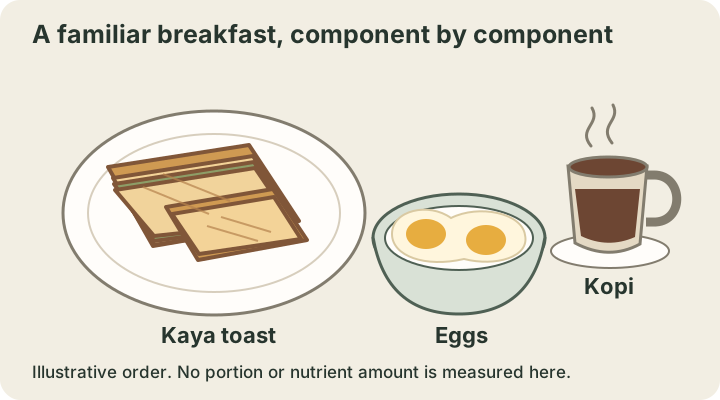
Kaya toast
Toast is part of this breakfast. The amount and recipe affect its nutrients; this illustration does not estimate them.
Eggs
Eggs are a clear protein-containing component you can identify in this breakfast.
Kopi
Milk and sugar vary with the order. A cup’s appearance does not establish its nutrient content.
Sources and example notes
Illustrated kaya-toast breakfast: toast on a plate, two eggs in a small bowl and a cup of kopi. The eggs are the highlighted protein-containing component; no nutrient total is supplied.
- HealthHub: Seniors Need More Protein — Familiar protein-containing foods including eggs, tofu, fish and lentils. No numerical meal estimate or individual target is taken from this lesson.
Reviewed . Publisher: SG Home Wellness. How we review and correct content.
Can a fish-soup photo tell you the protein amount?
Interactive example · Explanation explored
Can a fish-soup photo tell you the protein amount?
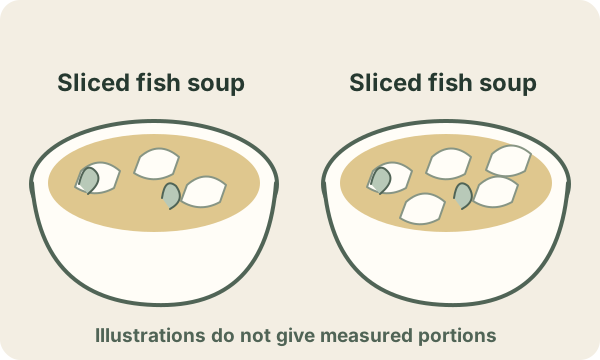
Two stalls both call a dish sliced fish soup. The bowls may contain different portions and recipes.
Show the explanation
A name or photo can help you recognise a food, but it does not establish the fish’s edible weight, the recipe or a precise protein amount. Ask what is included and look at the portion actually served. Use a reliable panel or a defined recipe and measured portion when numerical comparison is needed. A photo alone cannot supply that detail.
Keep in mind
Use a dish name to identify the meal, not an exact nutrient amount. Check ingredients and the portion actually served; do not turn a photo into a precise protein figure.
Saved in this browser. No automatic sync between devices.
Dish name
Sliced fish soup
Recognises a type of dish.
Still unknown
Actual fish amount and recipe
Piece size, ingredients and portion can vary.
Sources and example notes
Two illustrative bowls labelled sliced fish soup. One drawing shows fewer fish pieces, the other more. They do not establish edible weight, recipe or an exact nutrient amount.
- HealthHub: Survive Hawker Paradise — Hawker-food choices and portions need context; a dish name alone is not a nutrient panel.
- HealthHub: Seniors Need More Protein — Familiar protein-containing foods including eggs, tofu, fish and lentils. No numerical meal estimate or individual target is taken from this lesson.
Reviewed . Publisher: SG Home Wellness. How we review and correct content.
Remember what I learned
Keep a useful cue and find the explanation again.
Which note will help you find the setup again?
Interactive example · Explanation explored
Which note will help you find the setup again?
After a demonstration, you want one reminder for your next visit. These fictional notes are compared, not collected from you.
Show the explanation
A useful reminder identifies the machine, records its setting and keeps one clear cue or question. For example: “Chest press by window; seat 4 on this machine; check seat lock; return handles slowly.” The setting is a fictional record, not advice for you. Keep personal practice notes in your own notebook or phone. Saved references here keep public explanations rather than a private training log.
Keep in mind
For a private setup note, keep the machine, its setting and one cue or question. A public saved reference keeps the method handy without collecting your personal log.
Saved in this browser. No automatic sync between devices.
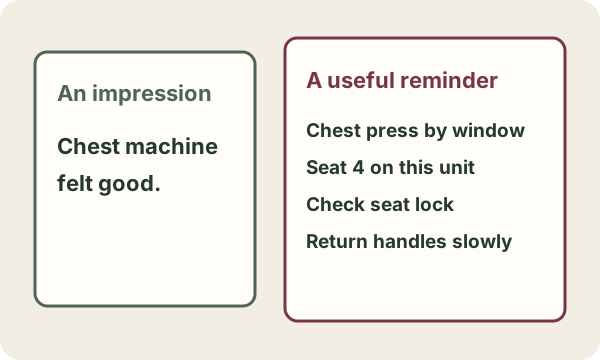
General impression
“Chest machine felt good”
Does not identify the unit, setting or cue.
Useful reminder
Machine + setting + one cue
“Chest press by window; seat 4; check lock; return handles slowly.”
Sources and example notes
Two fictional notes: “Did the chest machine, felt good” and “Chest press by window; seat 4 on this machine; check seat lock; return handles slowly.”
- HealthHub: Don’t Forget Your Form — Qualified help with understanding exercise setup and technique.
Reviewed . Publisher: SG Home Wellness. How we review and correct content.
Does a muscle picture show how to do the movement?
Interactive example · Explanation explored
Does a muscle picture show how to do the movement?
A chest-press tutorial includes a real demonstration, written setup and movement steps, and an optional 3D muscle-location view.
Show me the difference
A muscle-location picture answers “where is this muscle?” The setup and movement sequence answer different questions: how the equipment is prepared and what the described movement involves. Read those steps before exploring anatomy. A coloured region or a working 3D viewer does not confirm your technique or establish that an exercise suits you.
Keep in mind
Use anatomy to locate a muscle. Use the separate setup and movement steps to understand the task, and ask for feedback when you need it.
Saved in this browser. No automatic sync between devices.
Muscle location
Where a muscle is
A map helps you find a named anatomical region.
Technique explanation
What to set up and do
Watch the demonstrated version and read its equipment setup and movement steps, then seek feedback where needed.
Sources and example notes
Two reference types: a muscle-location map explains where a muscle is; movement instructions explain setup and action.
- HealthHub: Don’t Forget Your Form — Qualified help with understanding exercise setup and technique.
- ACE: Seated Chest Press — Equipment preparation and movement instructions are separate from identifying an anatomical region.
Reviewed . Publisher: SG Home Wellness. How we review and correct content.
Know the action, but not the exercise name?
Interactive example · Explanation explored
Know the action, but not the exercise name?
You want the reference for getting up from a chair. You do not need to know gym terminology first.
Show me the difference
Try the action you recognise, such as “getting up from a chair”, or the equipment you have. “Chair rise” and “sit-to-stand” point to the same existing reference. Watch its demonstration and read its setup and written steps; a search match alone does not establish that the movement suits you. You can go straight to the library without exploring a lesson first.
Keep in mind
Search an everyday action or equipment name. “Getting up from a chair”, “chair rise” and “sit-to-stand” lead to the same video and written tutorial.
Saved in this browser. No automatic sync between devices.
Everyday action
Getting up from a chair
A useful search phrase.
Other names
Chair rise · Sit-to-stand
Names for the same existing reference.
Sources and example notes
Getting up from a chair, chair rise and sit-to-stand are names for the same movement tutorial.
- NHS: Strength exercises, sit-to-stand — Sit-to-stand is the movement of rising from a chair and returning. Suitability and execution remain in the full reference.
Reviewed . Publisher: SG Home Wellness. How we review and correct content.
What makes two practice notes easier to compare?
Interactive example · Explanation explored
What makes two practice notes easier to compare?
You look back at two fictional visits to the same machine. One note records conditions; another only says “stronger today”.
Show the explanation
Keep the machine and setup, what happened and anything that changed. In these fictional visits, the repetition count varied and the person found the seat release without help. That describes two observations; it does not prove a change in strength. Look across repeated comparable practice and discuss the meaning with your coach. A general feeling can be worth noting, but it answers a different question.
Keep in mind
Compare repeated observations with their conditions attached. Record what happened and what changed; one visit or an impression alone does not establish a strength change.
Saved in this browser. No automatic sync between devices.
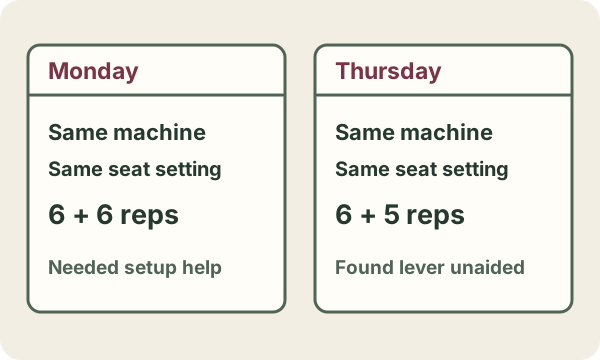
Monday
Same machine · seat 4
Two sets of 6. Needed help finding the seat release.
Thursday
Same machine · seat 4
6 then 5. Found the release without help; stopped when less in control.
General impression
“Stronger today”
Does not say what happened or whether conditions were comparable.
Sources and example notes
Fictional repeated observation: on the same chest-press machine and seat setting, Monday records two sets of six; Thursday records six then five, plus setting up without help. General impression: “stronger today”.
- HealthHub: Don’t Forget Your Form — Qualified help with understanding exercise setup and technique.
- CDC: Getting started with physical activity — Recording activity can help establish a routine. The fictional comparison is an editorial teaching example, not a validated test.
Reviewed . Publisher: SG Home Wellness. How we review and correct content.
Explored means you deliberately opened an explanation. It does not record comprehension, exercise or physical ability. Exploration stays in this browser, separately from saved references.