Interactive example · Explanation explored
What do these controls change?
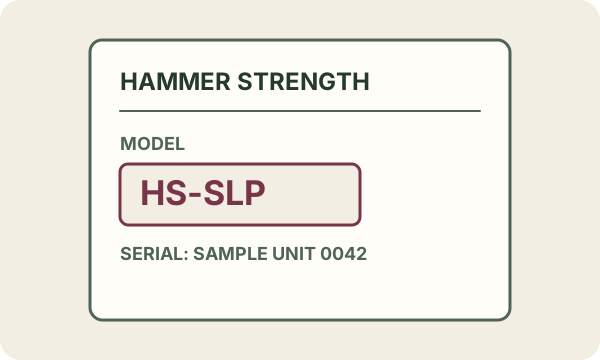
Example: Hammer Strength HS-SLP leg press.
Show me the difference
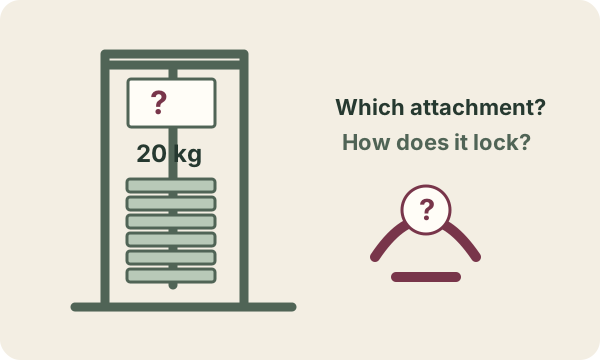
On this HS-SLP leg press, the release lever on the left side of the seat adjusts the starting position. The weight-stack selector chooses resistance. These are separate jobs. This model uses the seat adjustment to change the start position; another machine may have a separate range or handle control. Check the exact model instructions and ask for help if an adjustment is unclear or will not lock.
Keep in mind
HS-SLP: seat release = starting position; weight-stack pin = resistance. Check the model instructions and that adjustments lock.
This is the HS-SLP example, not a setting to copy to another machine. It does not choose a suitable position or resistance for you.
Saved in this browser. No automatic sync between devices.
Seat release lever
Starting position
On the HS-SLP, the seat adjustment changes where the press begins.
Weight selector pin
Resistance
Selects the stack setting. It does not change where you sit.
Sources and example notes
Two controls on the Hammer Strength HS-SLP have separate jobs: the seat release changes the starting position; the weight-stack pin selects resistance. See the linked manufacturer diagram for their locations.
- Hammer Strength Select owner’s manual, HS-SLP setup, printed page 52 — The left-side seat lever adjusts start position; selected resistance is checked separately.
Reviewed . Publisher: SG Home Wellness. How we review and correct content.
Make a food choice
Interactive example · Explanation explored
Which drink has more protein in the same amount?
Two fictional drinks have different pack sizes. First choose a common volume for the comparison.
Show the explanation
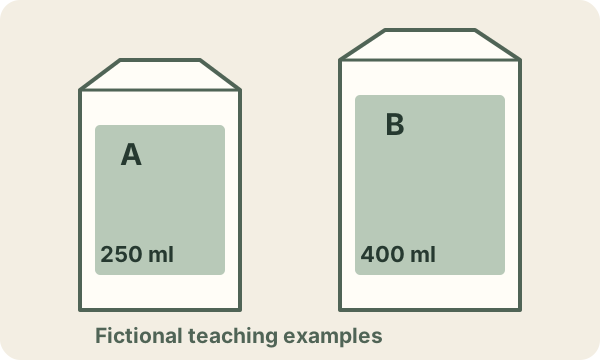
Use the per-100-ml column to compare an equal amount: A has 3 g protein and B has 2 g. Then check what you will actually drink. A’s 250 ml pack has 7.5 g protein; B’s 400 ml pack has 8 g because it contains more drink. This comparison describes these two nutrients and quantities; it does not choose a drink for your individual needs.
Keep in mind
Compare the same volume first. Then check the pack or portion you will drink; a larger pack can have a larger total even when its per-100-ml value is lower.
Saved in this browser. No automatic sync between devices.
Fictional teaching labels. These are not real products.
Fictional Drink A
Per 100 ml
- Protein
- 3 g
- Total sugar
- 4 g
Fictional Drink B
Per 100 ml
- Protein
- 2 g
- Total sugar
- 3 g
Read both quantities in a table
| Drink | Quantity | Protein (g) | Total sugar (g) |
|---|---|---|---|
| Fictional Drink A | 100 ml | 3 | 4 |
| Fictional Drink A | 1 pack, 250 ml | 7.5 | 10 |
| Fictional Drink B | 100 ml | 2 | 3 |
| Fictional Drink B | 1 pack, 400 ml | 8 | 12 |
Sources and example notes
Fictional Drink A: 250 ml pack, 3 g protein and 4 g sugars per 100 ml. Fictional Drink B: 400 ml pack, 2 g protein and 3 g sugars per 100 ml.
- HealthHub: Understanding food labels — Nutrition panels distinguish per-serving and per-100-g/ml values. Compare equivalent quantities. Fictional lesson numbers are original arithmetic examples, not HealthHub product data.
Reviewed . Publisher: SG Home Wellness. How we review and correct content.